Working With
Plasticine
Warm Up! When beginning a plasticine
project, it's a good idea to take a few minutes to squish
and knead a small piece of clay in your hands. It will
get you in the mood, warm up your hands and soften the
clay.
Modeling clay is available in many
colours, but you can make even more by mixing colours
together. For example: a small amount of red and yellow
plasticine kneaded together will gradually become orange.
Adding white will make colours lighter. Brown, red,
white and yellow can be combined in different amounts
to make a variety of skin tones. Colour that are partially
mixed have a marbled look that can be used for interesting
effects as well.
When I am working on a book I keep an extra board with samples of the colours I have mixed, with notes to help me remember how I made them.
Picture Building
The formal name for this type of
artwork is " Relief: a way of carving or moulding
in which the design stands out from the general surface."
Carvings on ancient temples and faces on the coins in
your pocket are examples of relief sculpture. Plasticine
pictures are made by building up layers of clay. I use
three basic techniques to make a plasticine relief picture.
1. Spreading
After planning my picture first
with pencil and paper, I choose a piece of illustration
board to work on. Illustration board is a heavy cardboard
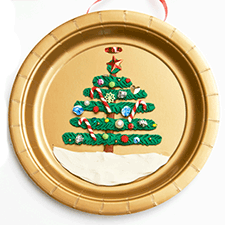
available at art supply stores, but heavy paper plates,
cardboard, plastic lids and even CD jewel cases will
work. Just make sure the material you work on is strong
enough to support the heavy clay without bending too
much.
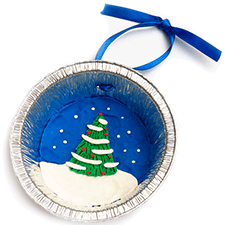
I start by spreading out a background
using my thumbs and fingers and adding small pieces
until the area is covered. Spreading a background provides
a sticky surface to add small details to. The background
is the farthest thing away in your picture. For example,
an outdoor scene might have a blue sky background. You
might choose a black background for an outer space picture;
a scene inside an igloo could have a white background.
Your background can also combine
colours, such as yellow for a sandy a beach with blue
for the ocean. By smearing a blob of pink or orange
across a blue sky you can create a sunset. Smearing
several kinds of blues, greens and purples together
can give an under water effect.
2. Modeling
You can make all sorts of shapes
in your fingers and stick them onto the background to
build up layers that form a picture.
A round pancake shape can be pressed
on to make a yellow sun, someone's rosy red cheeks,
or several can be piled up to form a puffy white cloud.
By rolling clay with a flat hand
on a hard surface you can make a long snake- like shape.
Those long strings of clay can be used to create hair,
tree branches, smoke rising from a chimney or stripes
on a tiger.
Many simple shapes can add up to
make a very detailed picture.
3. Adding Texture
Once your picture has a background
and some details you can add texture to make it even
more interesting. I use some tools for this.
With a sharp pencil you can "draw" lines in
the clay to add a smile to a face, or whiskers to a
snout. You can poke little dots to make eyes, nostrils
or nail holes in a fence.
A plastic knife or thin ruler edge
can cut straight lines to make the edges of buildings
or machines.
A small comb or fork can be used to scratch a grassy
or furry texture.
A tooth brush pressed into the surface gives a fuzzy
look. Just make sure it is a toothbrush no one wants
anymore! I use my imagination to think up the textures
I want, and look around the house for tools to help
me.
One of the best things about modeling clay is that if
something doesn't work at first, you can easily pick
it off, squish it up and try again. There is only one
rule I know of for working with plasticine: don't let
it get in the carpet!
By combining spreading, modeling
and adding texture you can create just about any picture
imaginable. Have fun!
You can find more tips and ideas
in my book Fun
With Modeling Clay or in the Project pages of this section.
|